メニュー
JP | JPY
-
-
- Challenges and Chances: A Review of the 1st Stem Cell Community Day
- Summertime, and the Livin’ Is Easy…
- Follow-on-Biologics – More than Simple Generics
- Bacteria Versus Body Cells: A 1:1 Tie
- Behind the Crime Scene: How Biological Traces Can Help to Convict Offenders
- Every 3 Seconds Someone in the World Is Affected by Alzheimer's
- HIV – It’s Still Not Under Control…
- How Many Will Be Convicted This Time?
- Malaria – the Battle is Not Lost
- Physicians on Standby: The Annual Flu Season Can Be Serious
- At the Forefront in Fighting Cancer
- Molecular Motors: Think Small and yet Smaller Again…
- Liquid Biopsy: Novel Methods May Ease Cancer Detection and Therapy
- They Are Invisible, Sneaky and Disgusting – But Today It’s Their Special Day!
- How Many Cells Are in Your Body? Probably More Than You Think!
- What You Need to Know about Antibiotic Resistance – Findings, Facts and Good Intentions
- Why Do Old Men Have Big Ears?
- The Condemned Live Longer: A Potential Paradigm Shift in Genetics
- From Research to Commerce
- Chronobiology – How the Cold Seasons Influence Our Biorhythms
- Taskforce Microbots: Targeted Treatment from Inside the Body
- Eyes on Cancer Therapy
-
-
-

-
-
- Challenges and Chances: A Review of the 1st Stem Cell Community Day
- Summertime, and the Livin’ Is Easy…
- Follow-on-Biologics – More than Simple Generics
- Bacteria Versus Body Cells: A 1:1 Tie
- Behind the Crime Scene: How Biological Traces Can Help to Convict Offenders
- Every 3 Seconds Someone in the World Is Affected by Alzheimer's
- HIV – It’s Still Not Under Control…
- How Many Will Be Convicted This Time?
- Malaria – the Battle is Not Lost
- Physicians on Standby: The Annual Flu Season Can Be Serious
- At the Forefront in Fighting Cancer
- Molecular Motors: Think Small and yet Smaller Again…
- Liquid Biopsy: Novel Methods May Ease Cancer Detection and Therapy
- They Are Invisible, Sneaky and Disgusting – But Today It’s Their Special Day!
- How Many Cells Are in Your Body? Probably More Than You Think!
- What You Need to Know about Antibiotic Resistance – Findings, Facts and Good Intentions
- Why Do Old Men Have Big Ears?
- The Condemned Live Longer: A Potential Paradigm Shift in Genetics
- From Research to Commerce
- Chronobiology – How the Cold Seasons Influence Our Biorhythms
- Taskforce Microbots: Targeted Treatment from Inside the Body
- Eyes on Cancer Therapy
-
-
-
JP | JPY
Sorry, we couldn't find anything on our website containing your search term.
384-well plates vs 96-well plates - Which is best?
Lab Academy
- 細胞生物学
- ピペッティングと分注
- 効率
- ピペット
- チップ
- エッセー
It cannot be ignored: The workload in labs is constantly growing. 25 years ago, working with 96-well microplates may have been progressive but nowadays an increasing number of labs are changing to 384-well plate format. Super, now you have four 96-well plates on a single plate – just with wells in miniature format. But what is the advantage? When comparing 384-well plate vs 96-well plate formats, the differences in efficiency and costs become clear. Let´s take a closer look at the advantages of 384-well plates.
How do you save space, reagents and money by using less material?
When debating the benefits of 384-well plate vs 96-well plate formats, storage space is a major advantage. Instead of storing four 96-well plates, you only need room for one plate. That looks especially good in the fridge, the freezer or the store cupboard. But it gets even better: One tip box or rack contains 4 times more tips than the standard (96) format - saving you a lot of space on the bench. This makes two real plus points! Less material also means that you can organize your workspace more efficiently and therefore save time.Another key factor when comparing 384-well plates vs 96-well plates is reagent volume.
In cases where it is possible to run an analysis using lower volumes, e.g. 40 µL instead of 150 µL, the 384-well plates provide many advantages. First and foremost, you save reagent. For example: Four 96-well plates filled with 120 µL per well need a total volume of approximately 46 mL. If the same analysis is miniaturized to a reaction volume of 40 µL per well, the total volume is decreased to 15 mL.
Expensive reagents such as those used in molecular biology can be saved and the cost per analysis reduced. Of course, this is only feasible if the reaction or analysis can be miniaturized.
Are you able to fill a 384-well plate manually within a minute?
Another advantage is you save time. Are you able to fill a 384-well plate manually within a minute? The answer to this question is that it highly depends on the type of pipette you use.
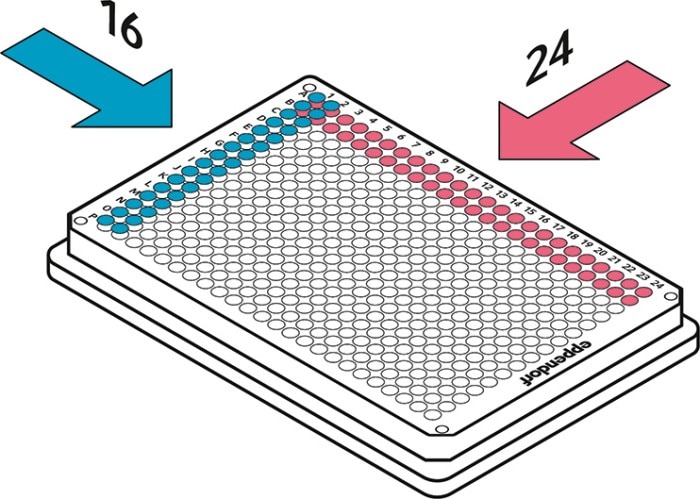
It is possible to fill 384-well plates with 8 or 12-channel pipettes. But then only every second well can be filled at one time.
On the one hand, this is highly error-prone ("oh, my centrifuge is ready… which was the next well to be filled?"). On the other hand, it is tiring and time-consuming. Just switching the plates to 384-well format and filling them with 8/12-channel pipettes is false economy.
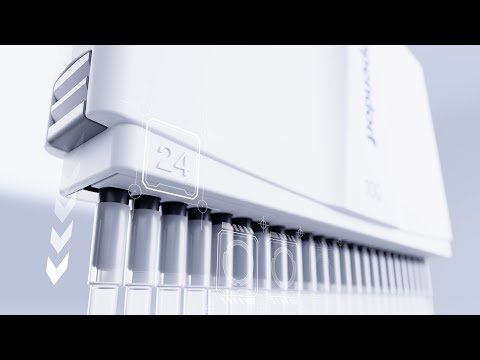
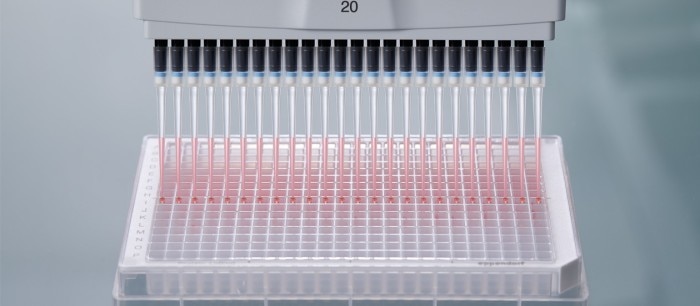
What you need is a reliable 16 or 24-channel pipette whose cone distances are harmonized to the distance between wells of a 384-well plate. And suddenly the work becomes more efficient.
When debating the benefits of 384-well plate vs 96-well plate formats, storage space is a major advantage. Instead of storing four 96-well plates, you only need room for one plate. That looks especially good in the fridge, the freezer or the store cupboard. But it gets even better: One tip box or rack contains 4 times more tips than the standard (96) format - saving you a lot of space on the bench. This makes two real plus points! Less material also means that you can organize your workspace more efficiently and therefore save time.Another key factor when comparing 384-well plates vs 96-well plates is reagent volume.
In cases where it is possible to run an analysis using lower volumes, e.g. 40 µL instead of 150 µL, the 384-well plates provide many advantages. First and foremost, you save reagent. For example: Four 96-well plates filled with 120 µL per well need a total volume of approximately 46 mL. If the same analysis is miniaturized to a reaction volume of 40 µL per well, the total volume is decreased to 15 mL.
Expensive reagents such as those used in molecular biology can be saved and the cost per analysis reduced. Of course, this is only feasible if the reaction or analysis can be miniaturized.
Are you able to fill a 384-well plate manually within a minute?
Another advantage is you save time. Are you able to fill a 384-well plate manually within a minute? The answer to this question is that it highly depends on the type of pipette you use.
It is possible to fill 384-well plates with 8 or 12-channel pipettes. But then only every second well can be filled at one time.
On the one hand, this is highly error-prone ("oh, my centrifuge is ready… which was the next well to be filled?"). On the other hand, it is tiring and time-consuming. Just switching the plates to 384-well format and filling them with 8/12-channel pipettes is false economy.
What you need is a reliable 16 or 24-channel pipette whose cone distances are harmonized to the distance between wells of a 384-well plate. And suddenly the work becomes more efficient.
もっと読む
3 x faster than alternate well pipetting
Once you are holding the optimal tool, you can get started. How much time do you think can be saved with a 24-channel pipette compared to a 12-channel? Lab personnel that had the chance to apply such an innovative pipette/pipette tip system reported: "3 times as fast as with 12-channel" and "50 % time saving" as well as "we have saved a complete working day". As an additional side-effect, incubations on a plate do not need to be started staggered or row-wise. You can now fill a plate in less than a minute.
384-well plate vs 96-well plate formats: which wins the battle?
Ultimately, the choice between 384-well plate vs 96-well plate formats depends on your lab’s throughput and resource priorities. If you can miniaturize your assays and you have 16/24-channel pipettes at hand, then 384-well plates are the winner in terms of efficiency, space, and costs.
But using the right tools is essential! Recognising this, the new Eppendorf Research plus and Xplorer plus 16/24-channel pipettes and pipette tips epT.I.P.S.® 384 are optimized for our 384-well plates, letting you work with speed and accuracy.
Once you are holding the optimal tool, you can get started. How much time do you think can be saved with a 24-channel pipette compared to a 12-channel? Lab personnel that had the chance to apply such an innovative pipette/pipette tip system reported: "3 times as fast as with 12-channel" and "50 % time saving" as well as "we have saved a complete working day". As an additional side-effect, incubations on a plate do not need to be started staggered or row-wise. You can now fill a plate in less than a minute.
384-well plate vs 96-well plate formats: which wins the battle?
Ultimately, the choice between 384-well plate vs 96-well plate formats depends on your lab’s throughput and resource priorities. If you can miniaturize your assays and you have 16/24-channel pipettes at hand, then 384-well plates are the winner in terms of efficiency, space, and costs.
But using the right tools is essential! Recognising this, the new Eppendorf Research plus and Xplorer plus 16/24-channel pipettes and pipette tips epT.I.P.S.® 384 are optimized for our 384-well plates, letting you work with speed and accuracy.
もっと読む
Related documents

Brochure
PDF
Eppendorf solutions
もっと読む
Upcoming Webinars
Watch our webinars and ask Eppendorf’s Application Specialists your questions.
もっと読む
Videos not loading, because cookies have been rejected. Change your